Bachelor in dance pedagogy

RésoNAnces is accredited by the French ministry of Culture to deliver the bachelor in classical, contemporary, and jazz aesthetics

Become dance teacher

Presentation


Program

Starting in the 2026–2027 academic year, RésoNAnces is updating its program to align with changes in the diploma’s French legal frame. The program, which is admission-based, is organized over three years to meet several objectives:

  • A long-term progression of the program featuring: greater interdisciplinary focus; more teaching simulations; more artistic encounters; broader development of choreographic, musical, and artistic culture; and a deeper understanding of the professional field (law, regulations, cultural issues, etc.).
  • A clearer connection between technique, pedagogy, and creation.
  • More structured support for each student’s professional development.

RNCP code : RNCP40006
Certification registration date : 05-12-2024
Certifier : French ministry of Culture

Career and program paths

The diploma is required to teach dance in France in both the public and private sectors, in the following disciplines: classical, contemporary, and jazz (law of July 10, 1989). It opens application for French public territorial agent admission.

The program offered by RésoNAnces prepares students for careers as dance teachers at conservatoires or associative dance schools. It also enables students to pursue further studies in the fields of the arts, education, arts outreach, or production.

Organization, duration

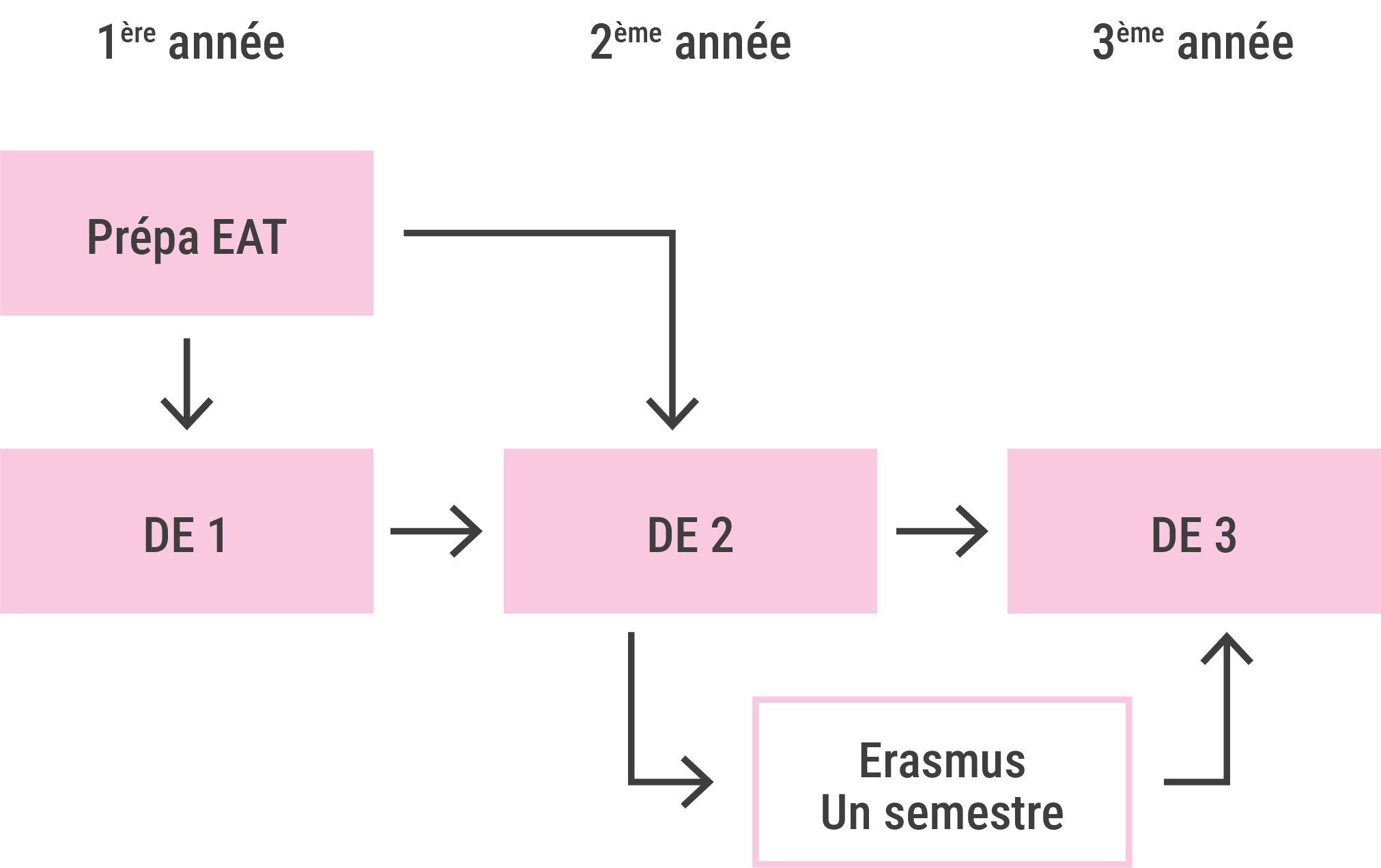
The bachelor in dance pedagogy is organized in three years. The combination with the preparation year for to the EAT (Examen d’Aptitude Technique) and the background of each candidate may allow a 2nd or 3rd year entry.
Je candidate

Curricula

The program offered meets the French national competences legal frame of the diploma, based on a curricula structured in 7 teaching units.

UE1 : Dance theroy and practice


Contents

  • Dance technical courses
  • Fundamentals of choreo langage of specificities
  • Specificity practice
  • Complementary practice courses
  • Masterclass.

UE2 : Choreography culture


Content

  • Dance history
  • Performing arts history
  • Choreogrpahy culture workshop

UE3 : Musical culture  


Contents

  • Music history
  • Dance/music connections

UE4 : Body knowledge


Content

  • Anatomy-physiology/ Movement functional and qualitative analysis
  • Artist’s health / Sexual and gender-based violence prevention

UE5 : Pedagogical practice year 2-year 3


Contents

  • Educational psychology
  • Dance pedagogy : courses for children (related to functional analysis of the dancing body)
  • Dance pedagogy : technical development course (related to functional analysis of the dancing body)
  • Reasearch method

UE6 : Scene practice


Contents

  • Composition and choreographic analysis
  • Residency period
  • Public events

UE7 : Territory and professional environment


Contents

  • Digital Skills/Information literacy/Research methodology
  • Modern languages
  • Communication/mediation/arts and cultural education
  • Tools for career development
  • Student civic engagement

Highlights

Practical training classes in early-years and introductory pedagogy, developed through collaborative projects with regional cultural, artistic, and educational stakeholders

Pedagogical tutoring programmes established for students in partnership with public and private teaching institutions, both within the Nouvelle-Aquitaine region and across France.

They enable artist-educators to connect with choreographers and their repertoires. These artistic pathways are developed in collaboration with multiple cultural partners and culminate in public performances.

In 2025, RésoNAnces, in partnership with the University of Bordeaux, was awarded a research call for projects for “Writing and Transmitting Dance” (Écrire et transmettre la danse), an initiative led by the institution for the past four years. Dance students are fully integrated into this research project.

These examinations, administered during the academic year under conditions identical to final evaluations, enable students to understand and experience the exam format firsthand.

As a structuring cornerstone of the institution, it is facilitated by the level of the pedagogical team professional network, which guides and supports students in bringing their career projects to fruition.

Mainly organized in partnership with La Manufacture CDCN Nouvelle-Aquitaine, these initiatives complement the students’ technical training and enable them to gain insight into the choreographic and pedagogical approaches of prominent figures from the dance world.

The RésoNAnces curricula offers students the opportunity to spend a time of their studies abroad through the Erasmus+ Programme. This provides a unique opportunity to strengthen foreign language proficiency, discover international repertoires, and experience a different pedagogical and artistic culture.

Équipe pédagogique

This section is currently being updated.

More
Admission to the training programme is performance-based, conducted via an audition.

Furthermore, entry is conditional upon passing the Technical Aptitude Examination (Examen d’Aptitude Technique – EAT) in the chosen option, or providing a recognized equivalent or waiver (in accordance with Appendix II of the Decree of April 11, 1995).
Candidates must be at least 18 years old by December 31 of their intake year.

The training programmes are accessible through multiple pathways: initial training, apprenticeships, continuing professional development, and the Validation of Prior Experience (VAE).

Initial training applies to individuals who have pursued their education without interruption. Conversely, continuing professional development is designed for those who have completed their studies, entered the workforce, and wish to resume their education. While these two statuses involve different funding models, they do not alter the content or the organization of the curriculum.

  • Tuition fees for a single artistic style are €300.
  • Tuition fees for two artistic styles are €500.

Scholarship-holding students are exempt from tuition fees but are required to pay registration fees.

This section is currently being updated

Any individual with a disability may request reasonable adjustments to their training programme to offset the impact of their disability, should it affect their ability to pursue their education.. (Cf. article 5211-2 et suivants le Code du travail). Contactez Catherine Barbosa ou Caroline Follana

For more informations about the bachelor in dance pedagogy, please contact the dance departement